
Release week, Seton Hill, and the plotting v. pantsing debate
Lots to cover, so buckle up buttercups...

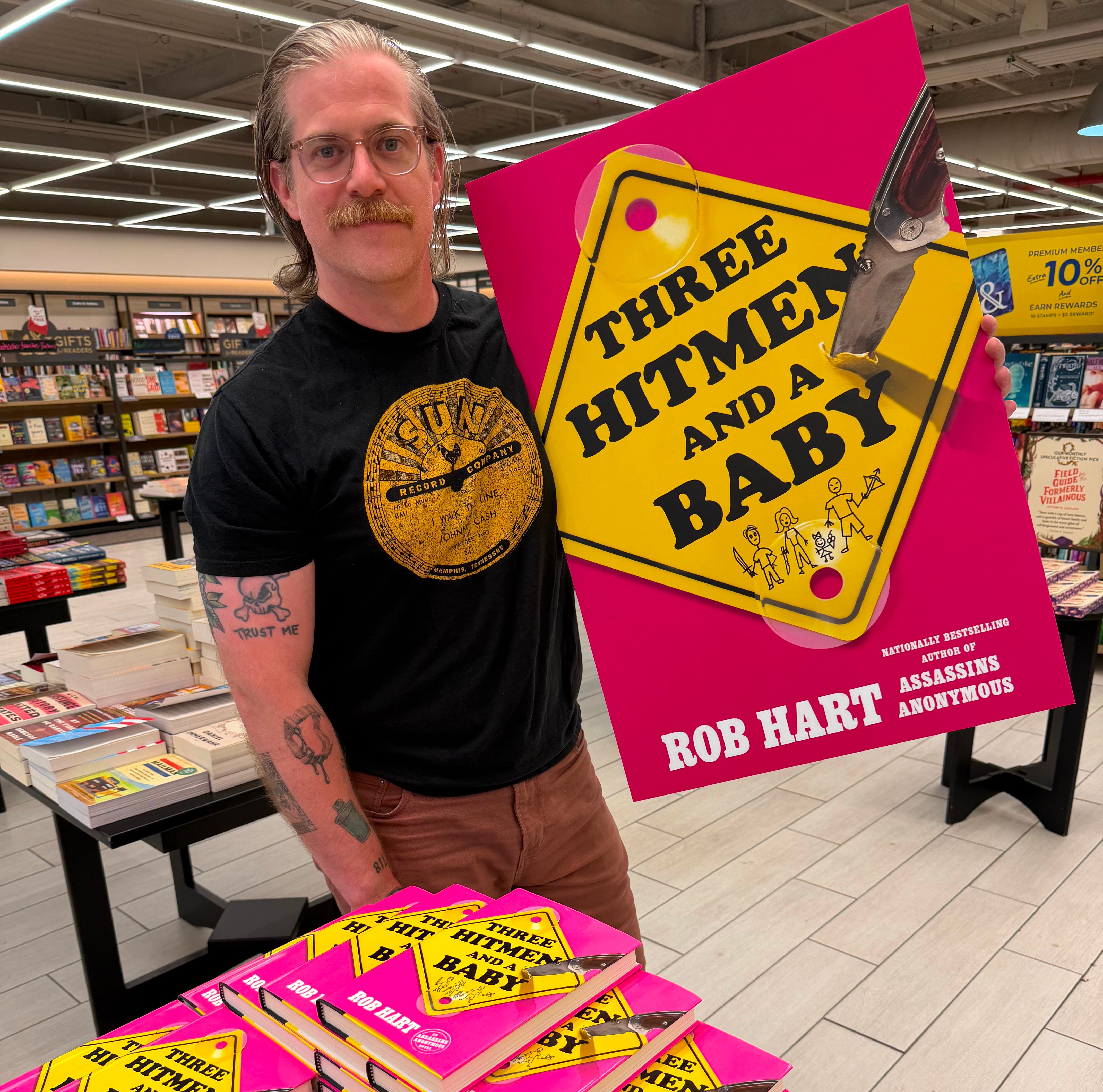
Three Hitmen and a Baby is out in the world! Thank you to everyone who bought it, came to an event, had me on their podcast, etc etc etc. The support was both endless and deeply appreciated.
If you haven’t gotten it yet, you can still order it here.
I think it went pretty well? It’s always hard to tell. But so far the people who’ve read it have seemed to like it, and that’s nice. While I’m mostly done with my official tour, I’ve got a few more events coming up:
July 7th, I’ll be at The Mysterious Bookshop in Manhattan, in conversation with Ron Currie, for his new book, We Will See You Bleed.
July 9th, I’ll be at Thrillerdelphia in… you guessed it… Philadelphia, with Jennifer Pashley, for her new book, The House Guest.
Me and Jennifer are looking at another event in Jersey later in July… more on that soon.
I’ll also be at the Writer’s Digest conference in New Brunswick, NJ. That takes place July 23-25. I’ll be there all day on the 25th, and I’m giving two lectures: one on writing outlines (and why you should), and one on writing secondary characters. But there’s a lot of great stuff on the agenda.
Registration is still open, and, my little gift to you is $50 off if you use the code SPEAKER50.
I’m writing this newsletter from the cafeteria of Seton Hill University, where I’m killing time before the graduation ceremony this afternoon. I have four students doing the walk and I could not be more proud of them.
In case you didn’t know, I’m a writing mentor in the Writing Popular Fiction MFA. It’s a great program, if you’re looking for something like that. The campus is gorgeous, the other faculty members are great. I’m particularly thankful they were willing to take me on, since I don’t have an MFA.
It’s a hugely rewarding experience, because despite my constant feelings of imposter syndrome, or that I’m a big dumb idiot who doesn’t know what he’s talking about… from an intellectual standpoint I do know that I understand this industry, and a thing or two about the craft of writing.
So here I am, molding young (or not young, it’s a graduate program) minds, and I take the responsibility of that very seriously.
One thing I have noticed, though, is something that’s happened more than once. So I want to take a moment to talk about the Plotting vs. Pantsing debate.
For those of you who don’t know, it’s this idea that when you’re a writer you need to make a decision: House Plotter (where you outline your story before you write it) and House Pantser, where you go with the writing gods with reckless abandon, working for the joy of the discovery.
And I’m coming around to the idea that this is Sorting Hat nonsense.
Because I’ve had a number of students now, who’ve come into their first semester, and excitedly declared themselves a pantser… and by the time they got to the end of their thesis (a novel), told me they regretted it and wished they had planned better.
I think the ability to pants a novel is a rare talent. I know a few authors who can do it. In terms of authors who operate on a high, professional level… I think I can count them on one hand.
The reality is, writing a novel is a big complicated thing. And writing without any kind of sense of where you’re going, thinking you’re going to figure it out along the way, is a recipe for disaster.
The pantsers tell me that writing with a plan takes away the joy. I get that. But I’m a plotter, and I discover stuff all the time when I’m writing. That said, I’m glad to have the framework of the story in place before I start, which is why these days I can write a novel in four to five months, from blank page to submission-ready.
I think of an outline as an old-school map: I know the starting point, I know the ending point. I have a rough sense of the route but I’m free to take a different path if there’s traffic, or something reveals itself to be worth exploring.
And look, I’m not saying your outline needs to be that in-depth, or rigid. I can get why that might take some fun out of it. But I would encourage all you pantsers out there to put some more consideration into some stuff… like what the big waypoints or set-pieces of the story will be. What the emotional catharsis is you’re writing toward, for both yourselves and your characters. What your favorite scenes might look like, and how they might be stitched together. Do some of your research ahead of time, because that will often inform the direction a story can take—more things to discover!
That kind of stuff can serve as a North Star, to lead you through the dark.
I think we need to retire this whole Plotter v. Pantser thing, and people need to realize that if you want to write a readable book (especially in genre fiction where certain tropes and structures are required), if you want to make it to the big leagues of publishing, you have to start laying some more groundwork before you get started.
Sorry, not sorry.
Okay, feel free to fight it out in the comments. Again, I am not saying no one should pants, ever. I’m just saying most people shouldn’t and it’s an unworkable process for most. But I said a thing on the internet which I know is akin to tossing a can of gasoline onto a bonfire…
Anyway. Thanks. Stay safe out there, folks.
Probably a dumb question but will you be signing copies at Thrillerdelphia?
I’m a devout Puzzler (basically a Chaos Pantser). It’s a misconception that Pantsers don’t need structure. Often, while my Plotter brethren are creating plot outlines, I’m meticulously forging a sandbox populated with complex characters and a detailed world. There is a lot of research and ideating before so sit down to write. Then I’m playing in a sandbox with rules built in to provide guardrails for my story. Further, once I get the skeleton of the story written organically I have to figure out the structure of the story and often use a storyboard to add scaffolding to the wild rumpus of the draft. I still contend that forcing organic writers to plot can hurt their development, but as pros who teach this stuff it’s an important conversation to have and I’m glad you’re talking about it.